

Why this matters
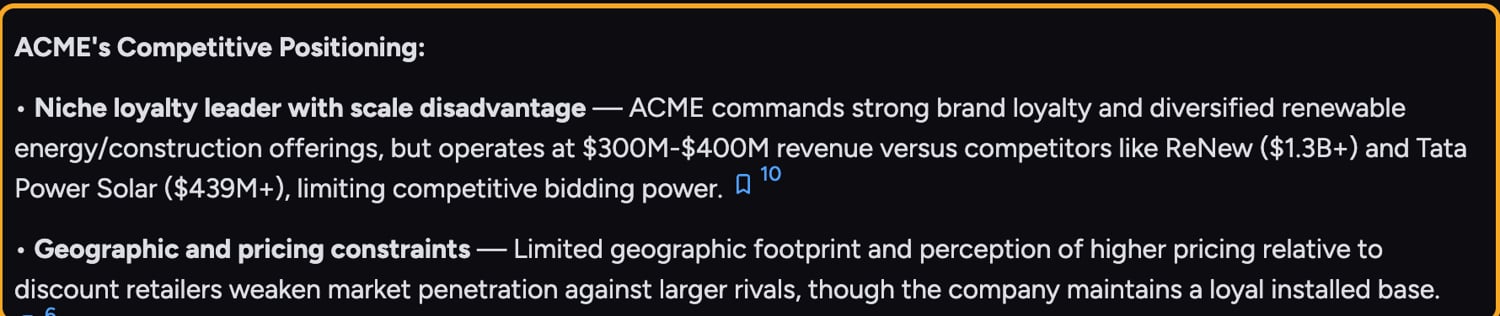
An answer you can’t trace is an answer you can’t trust. The thing that separates Chief from a generic chatbot is that nearly every claim it makes about your data comes with a citation — a clickable link back to the exact passage in the exact file it drew from. That means you can verify anything in one click instead of taking the model’s word for it, which is what makes Chief safe to use for board pre-reads, customer briefs, and anything that has to be right.How it actually works

- Knowledge base citations point to your uploaded files. They show the source filename and the excerpt, with the number of lines the passage spans.
- Web citations point to external sources the Explorer found on the open web.
- Artifact citations point back to outputs Chief itself produced earlier in your workspace.
A worked example
FAQ
Why does this answer have no citations?
Why does this answer have no citations?
Usually one of three reasons: the relevant file hadn’t finished processing when you asked, it isn’t part of the Project you’re chatting in, or the question was general knowledge rather than something grounded in your files. When a claim about your data lacks a citation, treat it as unverified and confirm it directly.
It cited the wrong passage or missed the one I expected — why?
It cited the wrong passage or missed the one I expected — why?
Retrieval matches passages by relevance, not by reading every word of every file. Vague questions retrieve broadly. Naming the document, the time period, or the specific term you care about helps Chief retrieve the precise passage you have in mind.
Can Chief cite the open web as well as my files?
Can Chief cite the open web as well as my files?
Yes. Web citations and knowledge base citations are rendered separately so you can always tell external sources apart from your own documents.